
The necessity of a precision tube resistance furnace lies in its ability to provide a highly stable thermal environment that maintains the exact temperatures (e.g., 1323 K) required to keep complex electrolytes in a molten state. Without this precise control, critical ternary systems like NdF3-PrF3-LiF cannot facilitate the complete dissolution of rare earth oxides, leading to inconsistent reaction kinetics and failed electrolysis.
The core value of this equipment is reproducibility through thermal dominance. By eliminating temperature fluctuations, you prevent the local solidification of electrolytes and variations in viscosity, ensuring that the electrochemical data you collect reflects the material's properties, not the equipment's instability.
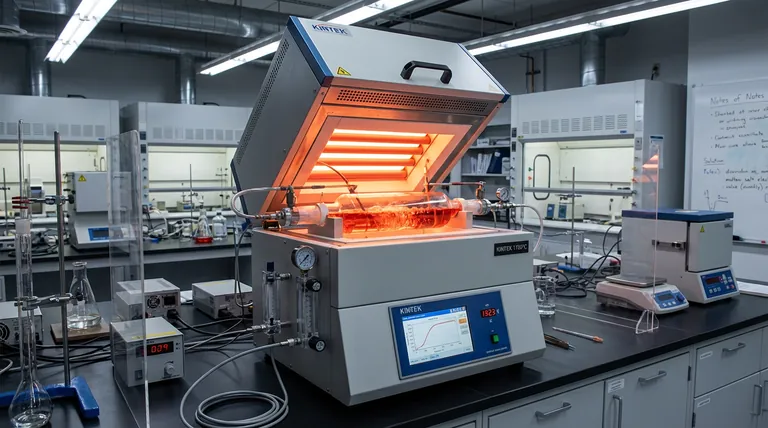
The Physics of Molten State Maintenance
Ensuring Phase Stability
Molten salt systems, such as the NdF3-PrF3-LiF ternary system, operate within narrow thermal windows. A precision furnace ensures the electrolyte remains completely liquid at high temperatures (e.g., 1323 K). Precise thermal regulation prevents local solidification, which can physically block ion migration and halt the electrolytic process.
Facilitating Complete Oxide Dissolution
For electrolysis to occur, the target oxides (such as Rare Earth Oxides or MRDO) must fully dissolve into the molten salt. In systems like sodium fluoride-cryolite (NaF–Na3AlF6), a stable heat source at 950°C is required to create the liquid phase environment. Incomplete dissolution due to temperature drops results in poor efficiency and incomplete reactions.
Stabilizing Reaction Kinetics
Electrochemical reaction rates are exponentially dependent on temperature. A precision tube furnace maintains a constant temperature, ensuring that the kinetics of the electrolysis remain stable throughout the experiment. This stability is critical for deriving accurate data on ion migration and redox reactions.
Environmental Control and Pre-treatment
Eliminating Contaminants via Calcination
Before electrolysis begins, raw materials often require rigorous pre-treatment to remove moisture. For example, calcining aluminum phosphate (AlPO4) at 1000°C removes chemically bonded water that would otherwise cause hydrolysis in chloride salt systems. Tube furnaces provide the high-temperature isolation needed to purify materials and prevent the formation of harmful by-products.
Regulating the Reaction Atmosphere
Unlike open heating methods, a tubular furnace offers a strictly enclosed heating environment. This allows researchers to control the atmosphere (aerobic or anaerobic) and heating rates with high granularity. Minimizing external interference is vital for generating standardized datasets and ensuring high-accuracy measurements.
Understanding the Trade-offs
Spatial Limitations
While tube furnaces offer exceptional precision, they are generally limited by the diameter of the tube. This restricts the volume of electrolyte and the size of the electrode assembly you can test. They are ideal for fundamental research and small-scale synthesis, but less suitable for scaling up to pilot production.
Thermal Gradients
Precision is typically highest in the center "hot zone" of the tube. Temperatures can drop significantly toward the ends of the tube where the heating elements terminate. Sample placement is critical; positioning the electrochemical cell outside the hot zone will lead to thermal gradients that ruin experimental validity.
Making the Right Choice for Your Goal
To maximize the utility of a precision tube resistance furnace, align its capabilities with your specific research objectives:
- If your primary focus is Fundamental Kinetics: Prioritize the furnace's ability to hold a constant temperature (±1 K) to ensure that viscosity and conductivity remain static during potentiostatic experiments.
- If your primary focus is Material Synthesis: Leverage the enclosed nature of the tube to strictly control the atmosphere, preventing oxidation or hydrolysis during the heating process.
- If your primary focus is Process Purity: Utilize the furnace for high-temperature calcination steps first to eliminate moisture that would otherwise destabilize the molten salt chemistry.
Ultimately, the precision tube furnace is not just a heater; it is the control variable that transforms volatile molten chemistry into a measurable, repeatable science.
Summary Table:
| Aspect | Benefit/Necessity |
|---|---|
| Stable Thermal Environment | Maintains exact temperatures (e.g., 1323 K) for molten electrolytes. |
| Phase Stability | Prevents local solidification and viscosity variations; ensures complete liquid phase. |
| Oxide Dissolution | Facilitates full dissolution of rare earth oxides (MRDO) for efficient reactions. |
| Reaction Kinetics | Stabilizes electrochemical reaction rates for accurate data on ion migration. |
| Contaminant Removal | Enables high-temperature calcination to eliminate moisture and impurities. |
| Atmosphere Control | Provides enclosed environment for precise regulation of aerobic/anaerobic conditions. |
Unlock unparalleled precision for your molten salt electrolysis research. Backed by expert R&D and manufacturing, KINTEK offers Muffle, Tube, Rotary, Vacuum, CVD systems, and other lab high-temp furnaces, all customizable for unique needs. Our solutions ensure the stable thermal environments and controlled atmospheres critical for accurate and repeatable experiments in material synthesis and process purity. Don't compromise on your results – contact KINTEK today to discuss how our precision tube furnaces can elevate your research!
ビジュアルガイド

参考文献
- Greenhouse Gas Emissions from Molten Fluoride Electrolysis Composed of Raw and Magnet Recycling Derived Oxides: A Comparative Study. DOI: 10.3390/ma18010184
この記事は、以下の技術情報にも基づいています Kintek Furnace ナレッジベース .



















