
A pyrolysis device serves as the central thermal reactor in the synthesis of supercapacitor materials, specifically designed to convert biomass precursors into porous carbon. It maintains a strictly controlled high-temperature environment that facilitates thermal decomposition, transforming raw organic matter into a stable, conductive carbon framework.
By precisely managing heat and atmosphere, the pyrolysis device drives the structural evolution of biomass into high-surface-area carbon, which is the essential prerequisite for high-performance energy storage.
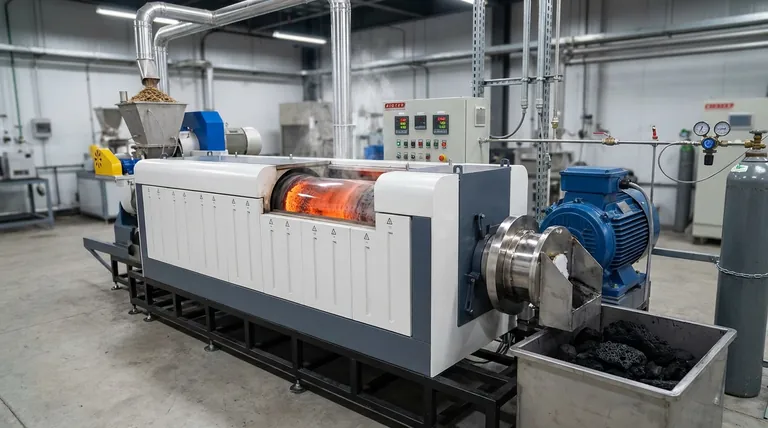
The Mechanism of Carbonization
To understand the role of the pyrolysis device, one must look at how it manipulates the physical environment to alter material chemistry.
Controlling the Atmosphere
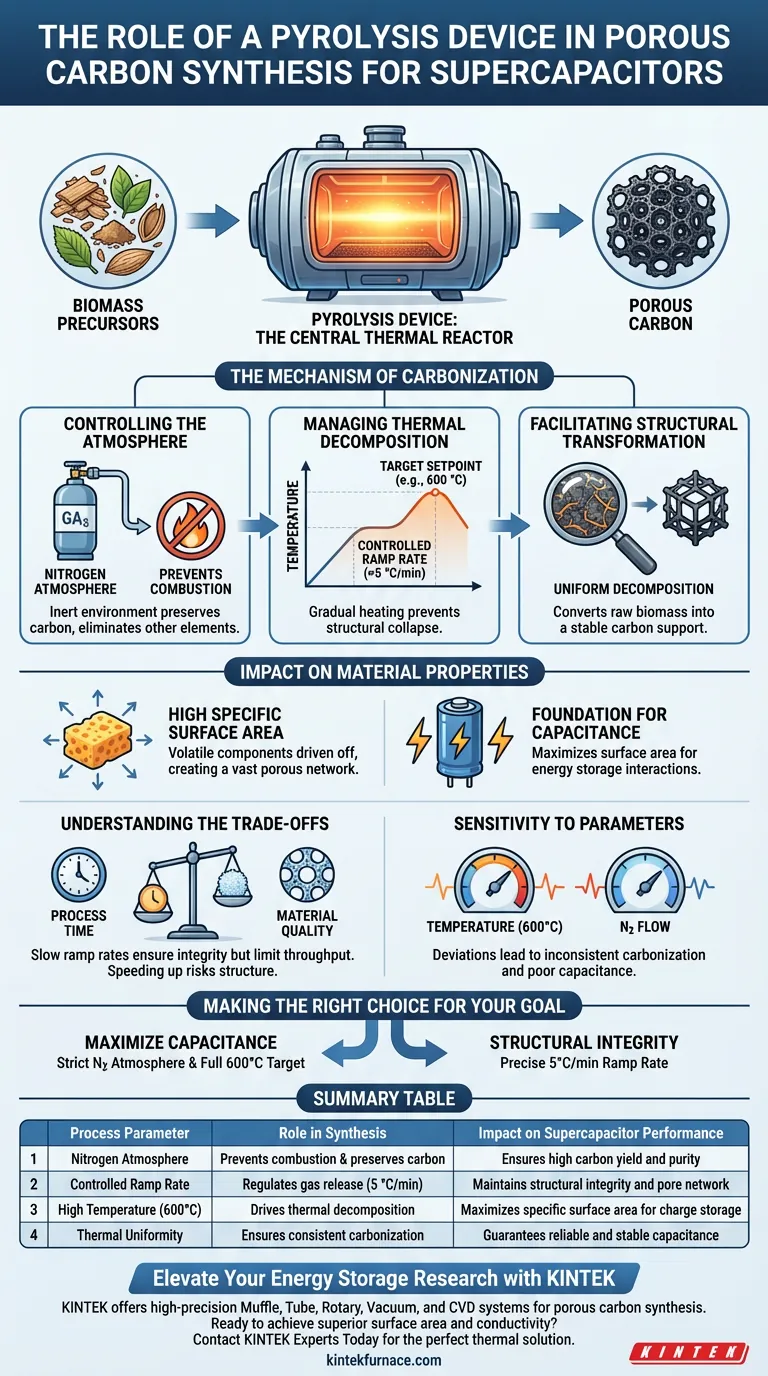
The device operates under a specific nitrogen atmosphere. This inert environment is critical because it prevents the biomass from combusting (burning) as it would in oxygen.
Instead of burning to ash, the organic material undergoes carbonization. This preserves the carbon structure while eliminating other elements.
Managing Thermal Decomposition
The device does not simply blast the material with heat; it applies a controlled ramp rate, typically around 5 °C/min.
This gradual increase prevents structural collapse caused by rapid gas release. The temperature is raised steadily until it reaches a target setpoint, such as 600 °C.
Facilitating Structural Transformation
At these high temperatures, thermal decomposition occurs. The device ensures this process happens uniformly throughout the precursor material.
This decomposition is what physically converts the raw biomass into a carbon-based support material.
Impact on Material Properties
The ultimate goal of using a pyrolysis device is not just carbonization, but the enhancement of specific physical properties required for supercapacitors.
Creating High Specific Surface Area
The primary output of this thermal process is a material with a high specific surface area. As volatile components are driven off by the heat, a porous network remains.
This porosity is the defining feature that allows the material to function effectively in energy storage applications.
Foundation for Capacitance
The porous carbon produced acts as the foundation for capacitance performance.
Supercapacitors rely on surface interactions to store energy. Therefore, the device's ability to maximize surface area directly correlates to the final electrical performance of the device.
Understanding the Trade-offs
While the pyrolysis device is essential, the process involves inherent constraints that must be managed.
Process Time vs. Material Quality
The requirement for a specific, slow ramp rate (e.g., 5 °C/min) creates a bottleneck in production speed.
Accelerating this heating process to save time risks compromising the structural integrity of the pores. You trade throughput for the high specific surface area necessary for performance.
Sensitivity to Parameters
The synthesis is highly sensitive to the device's accuracy.
Deviations from the target temperature of 600 °C or fluctuations in the nitrogen flow can result in inconsistent carbonization, leading to poor capacitance.
Making the Right Choice for Your Goal
When employing a pyrolysis device for supercapacitor research or production, align your parameters with your specific performance targets.
- If your primary focus is Maximizing Capacitance: Ensure the device maintains a strict nitrogen atmosphere and reaches the full 600 °C target to guarantee maximum surface area development.
- If your primary focus is Structural Integrity: Prioritize the precision of the ramp rate (5 °C/min) to prevent thermal shock and ensure uniform pore formation.
The pyrolysis device is not merely a furnace; it is a precision instrument that dictates the ultimate energy storage capability of your carbon material.
Summary Table:
| Process Parameter | Role in Synthesis | Impact on Supercapacitor Performance |
|---|---|---|
| Nitrogen Atmosphere | Prevents combustion & preserves carbon | Ensures high carbon yield and purity |
| Controlled Ramp Rate | Regulates gas release (5 °C/min) | Maintains structural integrity and pore network |
| High Temperature (600°C) | Drives thermal decomposition | Maximizes specific surface area for charge storage |
| Thermal Uniformity | Ensures consistent carbonization | Guarantees reliable and stable capacitance |
Elevate Your Energy Storage Research with KINTEK
Precise carbonization is the backbone of high-performance supercapacitors. Backed by expert R&D and manufacturing, KINTEK offers high-precision Muffle, Tube, Rotary, Vacuum, and CVD systems designed to meet the rigorous demands of porous carbon synthesis. Our customizable lab high-temp furnaces provide the atmosphere control and ramp-rate accuracy your unique biomass precursors require.
Ready to achieve superior surface area and conductivity?
Contact KINTEK Experts Today to find the perfect thermal solution for your lab.
ビジュアルガイド
参考文献
- Serkan Demirel, Mehmet Hakkı Alma. High capacitive pt and NiOx loaded supercapacitors with commercial and green synthesized carbon-based materials. DOI: 10.1007/s10854-023-11885-7
この記事は、以下の技術情報にも基づいています Kintek Furnace ナレッジベース .


